
Unlock the Potential of Your Home with HGR Informative

Valerie Douglass, Realtor
C: 860-389-0954
O: 860-739-6277
valeriedouglass.sites.cbmoxi.com
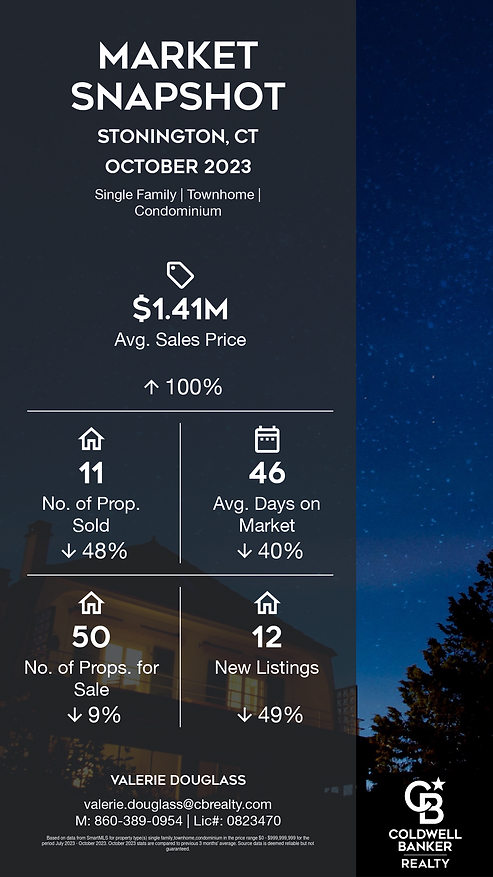
This week's snapshot feature:
Stonington
If you live in this area and were hesitant on selling with less homes currently for sale in this area your home may not be on the market long as trends show; and with a favorable sales price too!
Where Should I Live?
12 Important Factors To Consider
1. Your Housing Budget
This should be an important factor to weigh when you’re thinking of moving to a new place. Whether you’re looking to buy a house or rent a place to live, you’ll need to think about what you can afford each month for mortgage or rent.
Performing some basic calculations using different budget amounts can give you a better idea about what you can and can’t afford when it comes to buying a house. When determining your budget, your quality of life should always be top of mind to ensure you’ll be able to live a happy and healthy life.
2. Cost Of Living
Your housing budget is the first step of looking at your overall cost of living, which refers to how much money you spend to cover basic living expenses, such as groceries, child care, entertainment, gym membership, dining out and so on. Cost of living is an important consideration in determining how much home you can afford and where you choose to live.
For example, if you’re early in your career, choosing a thriving city with a high cost of living, such as San Francisco or New York City, might be worth the long-term career gains. Alternatively, having more disposable income to travel, invest in hobbies or build a nest egg for your real estate investment dreams may be more important and available to you than living in an employment hub.
A cost of living calculator can help you identify how much you might need to live in a certain area, and what you can expect to pay for common expenses.
3. Local Real Estate Market
The local real estate market goes hand-in-hand with your cost of living and your monthly housing budget. As you start your house hunt, take a look at whether there’s a buyer’s versus seller’s market which can affect your negotiating power when buying a house.
If there’s a buyer’s market, that means there are more available properties to choose from, and you may be able to negotiate more. If it’s a seller’s market, there may not be as many properties available to buy, so the seller has more power in the transaction.
Get approved to buy a home.
Rocket Mortgage® lets you get to house hunting sooner.
4. Job Opportunities
This might be a big consideration to take into account when you’re deciding on a place to live. How does the job market look? Are the jobs available the kind that would fit your skill set? Is it highly competitive?
There are many different industry hubs around the country – if you’re interested in pursuing a job with any of them, then that could be a factor in determining where to live. You’ll also want to look at average salaries in the area to make sure that you’ll be able to maintain your cost of living.
If you’re planning on working remotely, that’s an excellent solution. However, if you’re thinking about relocating to a new state while maintaining your current job, then be sure to check with your company to see if it’s allowed. Different states have different tax rules, and your company may not operate out of your desired state.
5. Big City Vs. Small Town
As you prioritize your desired locations, you’ll need to decide what kind of location you’d like to live in. A big city can offer a variety of places to live, restaurants, arts and culture, but it can come with a higher price tag. Conversely, a small town can offer wide open spaces and a lower cost of living, but you’ll likely have fewer restaurants and activities to choose from.
Each type of place has its benefits and drawbacks, so you’ll need to think about what’s important to you. The suburbs could be an excellent compromise. You’ll generally have more space than city dwelling, with access to the benefits of the city itself. You’ll probably have a slightly lower cost of living, too.
6. Outdoor Offerings
If you’re at all outdoorsy, consider what you might like to do in your new place. Do you need a huge piece of property for outdoor activities? Or would you prefer a city with a variety of parks? Looking for places to hunt, fish, swim or play sports could be high on your priority list.
Pets and kids will also affect your plan of where to live. If you have kids or dogs, think about what they might need. Playgrounds or dog parks could be an important factor for you. You might need a yard, for example, to ensure you don’t have to take your dog out on a leash for every bathroom break, or to ensure your kids can play outside and get some fresh air.
7. Climate And Weather
One important factor to consider is your desired climate. Are you a four-season person who welcomes the winter? Or are you more comfortable when it’s sunny and warm year-round?
The weather can affect all aspects of your life which is why it’s important to take a look at the weather patterns for your desired area. Is there too much rain to deal with? Are there droughts that might affect your daily lifestyle or hobbies?
If your region of choice is below sea level and/or next to a large body of water, there’s a possibility of flooding. If you’re seriously considering buying a house in a flood zone, ask neighbors or a real estate agent about it and make sure your new home insurance covers flooding.
8. Crime Rates
Do some research on crime rates in your desired area. It’s important to remember that crime rates can vary significantly even from neighborhood to neighborhood.
Crime rates can also affect external costs, such as insurance rates and costs of homes, so it’s a good idea to look into some of the safest cities in the U.S.
9. Education Systems
If you have children, or are planning to have them, this will likely be an important factor in your search for the right place to live. Take the time to research the schools in your desired area. Good schools make a neighborhood stand out, and families flock to areas with thriving local schools. Talking to parents with kids in the district can also help you gain an idea of what the schools are like.
Keep in mind that even if you don’t have kids, great schools can also raise property values.
10. Public Transportation
Public transportation might be something on your radar, especially if you don’t own a car or don’t wish to own one in the future. Major metro areas can have thriving public transportation systems, but most of the country doesn’t have an extensive train system. Buses and rideshares are common, but make sure you research how long it would take and what the costs are to get to your frequent places.
Commuting is often part of the transportation factor. If you’ll be commuting to work, keep in mind how long your commute would be. Take any weather into account – driving during snowy months can often take much longer.
11. Proximity To Family And Friends
Another factor to consider is how close you want to be to friends and family. You may rely on them for child care, or simply want to be close enough to visit with them whenever you want.
Figure out what this looks like for yourself or your family. Deciding to live near friends or family can help you whittle down your location list. Plus, you can visit them while you’re deciding, to get a sense of what it might be like to put down roots there.
12. Your Future Needs
Thinking about the future is something else to keep in mind as you’re finding a place to live. Are you planning on living in this new location for only a few years? That might affect what type of mortgage you get, or what kind of cost of living you might be able to handle. Or are you planning on staying for the foreseeable future?
If you’re beginning to grow your family, does the area have good child care? Will you be able to afford a home big enough to accommodate your expanding family?
Even if the answer to all of these questions is, “I don’t know,” it’s still something to keep in mind as you search for a place to live.

News 8 - Fall in Connecticut:
Your guide to Halloween, autumn events
Corn Mazes:
-
Bunnell Farm | 498 Maple St., Litchfield
-
Castle Hill Farm Inc. | 1 Sugar Ln., Newtown
-
Flashlight Maze at Wells Hollow Cemetery | 656 Bridgeport Ave., Shelton
-
Hidden Acres Corn Maze | 150 Exeter Rd., Lebanon
-
March Farm | 160 Munger Ln, Bethlehem
-
Preston Farms | 92 Rt. 2, Preston
-
Night Maze at Treat Farm | 361 Old Tavern Rd., Orange
-
Wells Hollow Farm | 656 Bridgeport Ave., Shelton
Hayrides:
-
Castle Hill Farm | 25 Sugar Ln, Newtown
-
Foster Family Farm | 90 Foster St., 90 Foster Rd., South Windsor
-
Harris Hill Farm | 106 Ridge Rd., New Milford
-
Karabin Farms | 894 Andrews St., Southington
-
Plasko’s Farm | 670 Daniels Farm Rd., Trumbull
-
Pickin’ Patch | Nod Road, Avon
Pumpkin Picking:
-
Fort Hill Farms | 18 Fort Hill Rd., New Milford
-
Johnny Appleseed’s Farm | 185 West Rd. (Rt. 83), Ellington
-
Lyman Orchards | 32 Reeds Gap Rd., Middlefield
-
Norton Bros. Fruit Farm | 466 Academy Rd., Cheshire
-
Pickin’ Patch | Nod Road, Avon
-
Pumpkintown U.S.A. | 93 E High St., East Hampton
-
Rose Orchards | 33 Branford Rd., North Branford
-
The Farm | 281 Road, CT-132, Woodbury
Haunted Houses:
-
Dark Manor | 25 Main St., Baltic
-
Demon House | 39 Prospect St, Enfield
-
Evidence of Evil | Lyman Orchards, Middlefield
-
The Foresaken Lands | Action Wildlife, Goshen
-
Fright Haven | 411 Barnum Ave. Cutoff, Stratford
-
Harvest Fair After Dark | 1230 Merwins Ln, Fairfield
-
Haunting at the Ridge | Powder Ridge, Middlefield
-
Haunt on Eden | Mount Southington Ski Area, Plantsville
-
Legends of Fear | Fairview Tree Farm, Shelton
-
Nightmare Acres | 240 Governors Hwy, South Windsor
-
Nightmare on Wolcott Street | 1058 Wolcott St., Waterbury
-
Phantom Fall Fest | Lake Compounce, Bristol
-
Rails to the Darkside | Connecticut Trolley Museum, East Windsor
-
Scarrybrooke Park Haunted Trail | 100 Still River Dr., New Milford
-
Trail of Terror | 60 N Plains Hwy., Wallingford
Ghost Tours:
-
Downtown Mystic Ghost Tour | Downtown Cottrell St., Mystic
-
Ghosts of New Haven | 1070 Chapel St., New Haven
-
Ghosts, Seances & the Great Beyond | 295 West Ave., Norwalk
-
Graveyard Shift Ghost Tours | Mark Twain House: 385 Farmington Ave., Hartford
-
Hallowed History Lantern Tour at Cedar Hill Cemetery | 453 Fairfield Ave., Hartford
-
Moonlit Mystic Graveyard Ghost Tour | Mystic
-
Paranormal Pub Crawl | Downtown Mystic
-
Spirits of Milford Ghost Walks | Factory Lane, Milford
-
Paranormal Experiences with Joe Franke | North Haven Library: 17 Elm St., North Haven
-
West Hartford Hauntings | Noah Webster House, West Hartford
Everything In-Between:
-
Ballet Spooktacular | 300 Main St., Old Saybrook
-
Curioporium | 1429 Park St., Hartford
-
Halloween Flea | Front Porch Brewing: 226 N Plains Industrial Rd., Wallingford
-
Halloween Masquerade Sip & Shop | 758 Rubber Ave., Naugatuck
-
Hollowed Harvest | Camp Mattatuck: 221 Mt Tobe Rd., Plymouth
-
Monster Mini Golf | 13 Stony Hill Rd., Bethel
-
NorWITCH Halloween Strut | 62 Bath St., Norwich
-
Pumpkin Mini Golf & Zombie Laser Tag | Sonny’s Place: 349 Main St., Somers
-
Pumpkin Passage | The Dinosaur Place: 1650 Hartford-New London Tpke., Oakdale
-
Putnam Great Pumpkin Festival | 110 Main St., Putnam
-
Rocky Horror Picture Show | Shubert Theatre: 247 College St., New Haven
-
Weirdo Wonderland | 225 Bridgeport Ave., Milford *https://www.wtnh.com/news/connecticut/fall-in-connecticut-your-guide-to-halloween-autumn-events/


Why is pricing your home important?
Contact me for your FREE MARKET ANALYSIS
Phone: (860)389-0954
Email: valerie.douglass@cbrealty.com
What is a free market analysis?
A free market analysis is a professional evaluation of your property's value based on a range of factors such as its location, size, condition, and comparable properties in the area. By getting a free market analysis, you can: Determine a realistic price range for your property based on market trends and conditions.
Vampire Energy
What is Vampire Energy? Vampire energy, also called phantom energy or standby power, is the electricity that some devices use when they're turned off but still plugged in to a power outlet.
Many modern consumer electronics continue to use power as long as they are plugged into an outlet. Even if the device is turned “off” it continues to use electricity because they’re designed to be convenient. Standby Mode may save you from having to wait longer for your television to turn on, but the fact that it turns on quickly usually means it's been drawing power the whole time.
These common devices are among those that frequently fall prey to vampire electricity:
-
Televisions
-
Cable boxes
-
Satellite boxes
-
Internet routers
-
Internet modems
-
Stereos
-
Printers
-
Scanners
-
Cellphone chargers
-
Cordless phones
-
Game consoles
-
Cameras
-
Portable vacuums
-
Microwave ovens
-
Electric clocks
How To Stop Vampire Energy
1. Unplug Devices After Use
This is perhaps the easiest thing to do. If you cut off the power supply, the energy guzzlers have nothing to feed on, drastically improving their energy efficiency.
2. Use Power Strips
A power strip or surge protector makes the unplugging job much easier. All you need to do is to switch off the power strip and that disconnects everything plugged into it.
There are also power strips that turn off devices depending on power usage. For instance, if you have your computer, TV, and stereo plugged into one power strip and you switch off the computer and stereo, the TV also gets turned off. Other power strips allow a master device to control how other devices use power, including turning them on and off along with any accessories these devices may have.
However, you probably have some devices that you never want to turn off, including the router that connects your home to the internet. In this case, you can purchase a smart power strip that allows you to control individual plugs via an app. That way you can turn each outlet on or off, set up a timer or schedule, and add custom automations to control specific devices.
3. Switch Off Screen Savers
If you don't want to switch off your desktop computer, you should still turn off the monitor completely instead of using a screen saver, since a screen saver keeps the monitor on and can use significant energy.
For your laptops or tablets, you should also disable the screen saver mode so you don’t waste energy, and look for other settings that maximize energy efficiency and minimize standby power usage.
4. Minimize Digital Displays
You don't need multiple appliances to light up every hour and tell you the time. Each time your coffee maker, bedside alarm clock, or DVD player light up, they silently consume more energy. Many modern electronics have ways to reduce the display options down to the bare minimum to reduce their total power consumption.
5. Adjust Power Settings on Heavily Used Devices
You can save a lot of electricity by reducing how your most popular electronics use power. Our recommendations include:
-
Disable the “Quick Start” mode on your TV
-
Set your computer to enter “Sleep Mode” after 5 to 10 minutes of inactivity
-
Turn off the “Instant On” mode for your game consoles
6. Use A Timer
Not every appliance can go a power strip, but sometimes you can install a timer instead, to help minimize power usage. Appliances such as a pool pump, hot water recirculation pump, or heated bathroom floor can be set on a firm schedule without significantly impacting their performance. Doing so ensures you only use electricity at very specific times, which helps you save energy and money on your electricity bills each month.
7. Switch to Energy Star Appliances
When your current vampire appliances start to wear out, you should replace them with new energy-efficient models that have the ENERGY STAR label. That blue Energy Star sticker guarantees that your new electronics have been designed to help you save energy, not draw vampire energy, and produce fewer emissions, and this accreditation is recognized by the Environmental Protection Agency (EPA).
*https://palmetto.com/learning-center/blog/vampire-energy-guide